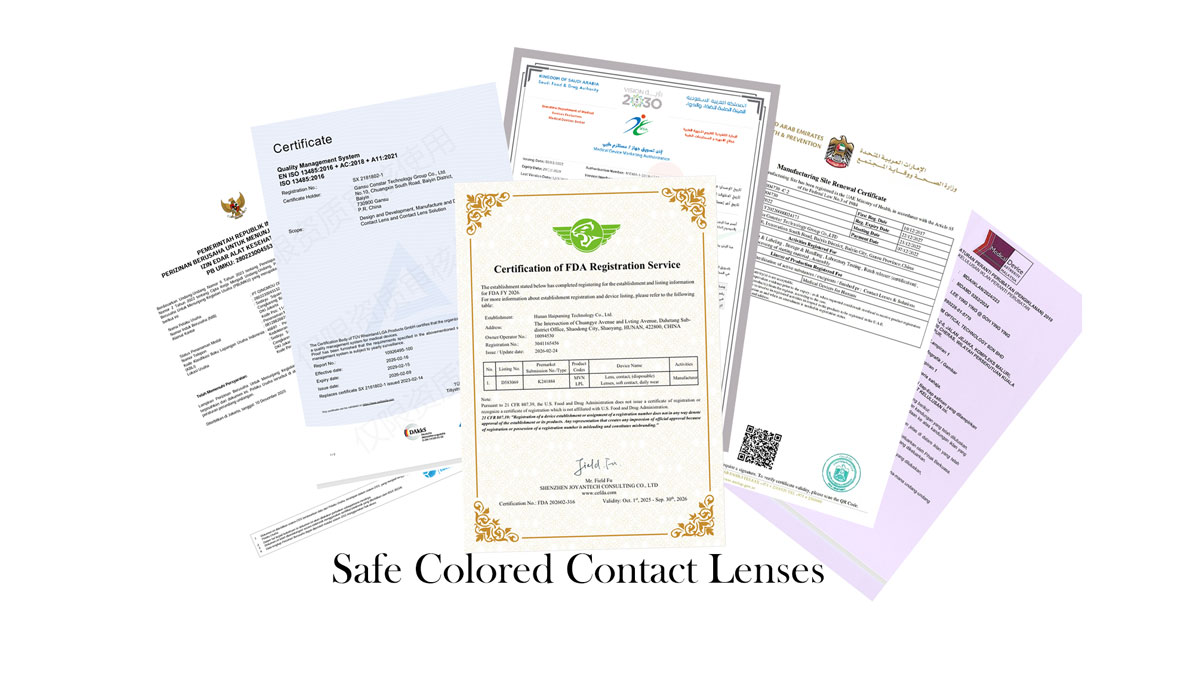
Why certificates are the first step to safety
For overseas sellers, colored contact lenses are not just “beauty products”.
In most countries they are treated as medical devices or heavily regulated products, which means poor compliance can easily lead to account suspension, product delisting, fines, or even legal liability.
Many sellers only look at designs, colors, and price, but rarely check whether the contact lens brand and products are truly compliant in their target markets.
This article gives you a simple, practical framework to evaluate different brands of contact lenses, and explains the three major types of certificates you should always check before partnering with any contact lens distributors or suppliers.
1.Product safety and quality related certificates
This part answers one core question: Are these contact lenses designed and manufactured according to medical‑grade safety standards?
Typical certificates and systems include:
-
FDA related registration / 510(k) (for the United States)
-
CE marking (for the European market)
-
ISO 13485 (medical device quality management system)
1) FDA / 510(k) – United States
In the US, contact lenses are regulated as medical devices, and many products need to go through 510(k) or related processes to prove safety and effectiveness.
If you are targeting the US or plan to enter this market later, it is much safer to choose a contact lens brand that has FDA‑related background instead of random, cheap options.
2) CE – European Union
A CE mark shows that the lenses comply with relevant EU medical device regulations and can be sold legally in EU member states.
For sellers targeting Europe, CE is a key baseline, and also reflects the overall quality level of the manufacturer.
3) ISO 13485 – Quality management system
ISO 13485 is the dedicated quality standard for medical devices.
It is not a “sales license” by itself, but it means the factory has built a professional system for material control, production process, quality inspection, and traceability, which is critical for stable, long‑term cooperation.
When comparing common contact lens brands, you should always ask whether the factory behind them holds FDA, CE, or ISO 13485.
This is usually what separates truly professional contact lenses brands from low‑end studios.
2.Country‑specific registrations and approvals
The second category is about local market approvals and registrations.
These certificates indicate that the lenses have been reviewed by local authorities and can legally enter the corresponding markets.
Below are common examples for popular markets (always follow latest local regulations):
-
Philippines: MDR / CPR
-
Malaysia: MDA Registration
-
Indonesia: AKL License
-
Thailand: TFDA Registration
-
Vietnam: Medical Device Declaration
-
Saudi Arabia: SFDA MDMA
-
United Arab Emirates: UAE Medical Device Registration
-
Australia: TGA ARTG
-
United States: FDA 510(k) (for relevant device classes)
If you mainly sell to Southeast Asia, the Middle East, or Australia, your contact lens brand names should be backed by at least some of these registrations.
When a supplier can show real, valid certificates in your key countries, it is usually a strong sign that their lenses are safer and easier to clear customs and pass platform checks.
3.Brand reputation and supply chain strength
Certificates tell you whether the product is compliant, but you also need to check whether the contact lens brand and supply chain are strong enough to support your business growth.
Key points to look at:
-
Whether the supplier has its own established brand with real overseas presence and repeat customers.
-
Annual sales volume (for example, over 600M+ lenses per year), which tells you their production and quality systems are mature.
-
Presence of overseas warehouses in Southeast Asia and the US, which shortens delivery time and makes replenishment easier.
-
Local offices or teams in key countries, so you can get support in the same time zone when issues arise.
-
OEM / ODM capability, allowing you to build your own colour contact lens brand, from design to packaging and documentation.
For example, a brand like Mislens, which already has recognition in overseas markets, ships over 600M lenses annually, and holds FDA, CE, ISO 13485 and multiple country registrations, is usually much more reliable than unknown small studios.
If you want to build a long‑term business and become one of the best contact lens distributors in your region, working with such partners will significantly reduce your risk and learning curve.
4.How to verify certificates quickly and effectively
When a supplier claims to be one of the best brands for lenses or offers “fully certified” colored contacts brand options, you should still verify the documents yourself.
Here is a simple checklist you can follow:
-
Ask for clear digital copies
-
Request high‑resolution scans or PDFs that include certificate number, issuing authority, issuing date, and expiry date.
-
Check company name and product model
-
Ensure the company name on the certificate matches the factory or brand you are talking to.
-
Confirm that the product name and model cover the types of contact lenses you actually plan to purchase.
-
Use official databases
-
Many authorities have public search systems for medical device registrations.
-
Enter the certificate number and compare the official information with what you received.
-
Watch expiry dates and applicable regions
-
Confirm the certificate is still valid.
-
Remember that approval for one country does not automatically mean global approval.
-
Test the supplier’s willingness to explain
-
Serious suppliers will patiently explain which certificates apply to which markets and products.
-
If they only say “we have everything, don’t worry” but refuse to show details, it is a red flag.
5.Questions you should ask every contact lens supplier
Whether you want to buy colored contacts for reselling on marketplaces, or are looking for the best site to buy contacts in bulk as a retailer, ask these questions:
-
Which countries/regions have your lenses already been registered in? Can you share the certificates and registration numbers?
-
Do you have FDA, CE, and ISO 13485? Which product lines do they cover?
-
Do you hold registrations such as MDA (Malaysia), TFDA (Thailand), Medical Device Declaration (Vietnam), SFDA MDMA (Saudi), UAE Registration, and TGA ARTG (Australia)?
-
Do you have overseas warehouses in Southeast Asia and the US? Which countries can you ship from, and what is the typical delivery time?
-
Do you support OEM / ODM for private labels? How long does it take from sample to mass production?
-
What is your approximate annual sales volume, and what types of clients do you mainly work with?
-
How do you handle quality disputes or regulatory issues in different countries?
These questions will help you filter out suppliers who only sell low‑cost, unregistered lenses, and find popular contact lens brands that are genuinely safe and sustainable for your business.
6.Choosing safe and reliable contact lens brands for long‑term growth
For overseas sellers, picking the best brand of eye lenses is really about safety, compliance, and long‑term support, not just about the cheapest price.
The ideal partner is a colour contact lens brand that can combine:
-
Strong product safety and quality (FDA, CE, ISO 13485, etc.)
-
Solid country‑specific registrations (Philippines MDR/CPR, Malaysia MDA, Indonesia AKL, Thailand TFDA, Vietnam Declaration, Saudi SFDA MDMA, UAE Registration, Australia TGA ARTG).
-
Proven supply chain strength: 600M+ lenses sold per year, overseas warehouses in Southeast Asia and the US, and on‑the‑ground local offices.
-
Full OEM / ODM service, plus an existing brand (such as Mislens) that already has recognition and trust in global markets.
When you put safety and compliance first, and work with truly professional contact lens brand suppliers, your business will be much more stable—whether you sell via marketplaces, offline channels, or your own website.